
Queues at scale: idempotency, retries, dead letters — a practical guide
A hands-on guide to building reliable queue systems in production: idempotency, smart retries, backoff strategies, and dead-letter queues—without duplicate jobs, retry storms, or hidden failures.

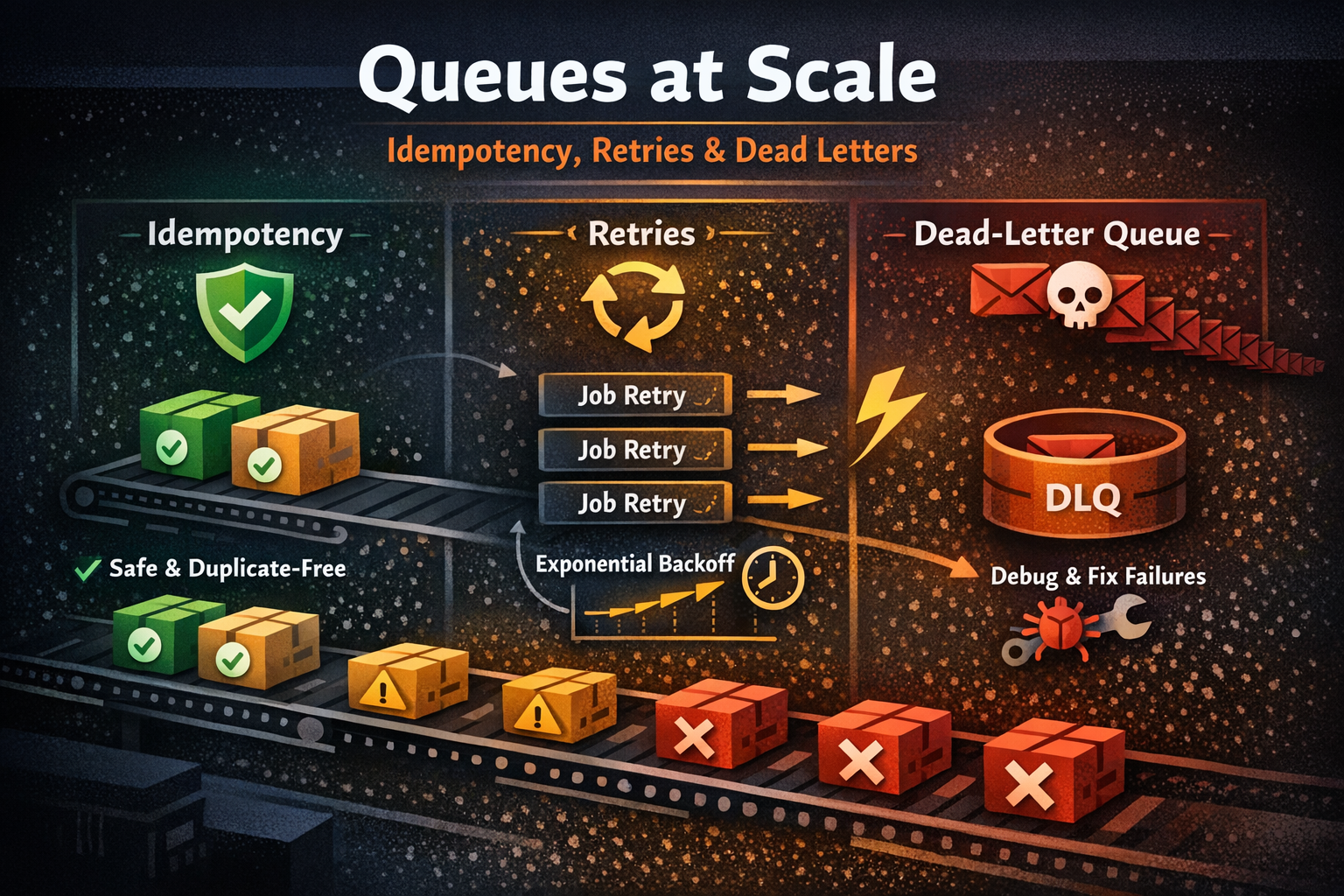
Queues look simple until your system is under real load.
At small scale, you can usually get away with:
- “Just retry it”
- “It probably won’t run twice”
- “We’ll check logs if something breaks”
At scale, that mindset turns into:
- Duplicate emails sent to customers
- Orders processed twice
- Infinite retry loops burning CPU and money
- Poison messages blocking entire queues
This post is a practical guide to three concepts that make or break queue-based systems in production:
- Idempotency (doing things safely more than once)
- Retries (when and how to retry without making things worse)
- Dead-letter queues (what to do when a message is truly broken)
Examples are generic, but this applies directly to Laravel queues, SQS, RabbitMQ, Kafka consumers, etc.
1. First: assume your job WILL run more than once
If you take only one thing from this article, take this:
At scale, every job must be safe to run multiple times.
Why?
- Workers crash mid-job
- Timeouts happen
- Network calls fail after the remote side already processed the request
- The queue system may redeliver the same message
- You may manually retry jobs
So you must design jobs to be idempotent.
2. Idempotency: making “run twice” safe
Idempotent means:
Running the same job 1 time or 10 times produces the same final result.
❌ Bad example (not idempotent)
public function handle()
{
    Order::find($this->orderId)->markAsPaid();
    Invoice::createForOrder($this->orderId);
    Mail::to($user)->send(new OrderPaidMail());
}
If this runs twice:
- You may mark the order paid twice
- You may create two invoices
- You may send two emails 😬
✅ Better: guard with state
public function handle()
{
    $order = Order::find($this->orderId);

    if ($order->status === 'paid') {
        return; // already processed, safe exit
    }

    DB::transaction(function () use ($order) {
        $order->markAsPaid();

        Invoice::firstOrCreate([
            'order_id' => $order->id,
        ]);

        Mail::to($order->user)->send(new OrderPaidMail());
    });
}
Key ideas:
- Check current state first
- Use unique constraints / firstOrCreate
- Wrap critical changes in transactions
- Design side effects to be deduplicated
Even better: idempotency keys
For external APIs or critical operations:
- Store a unique idempotency key (e.g.
event_id,message_id) - Before processing, check if it was already handled
- If yes → exit safely
This is mandatory when dealing with:
- Payments
- Webhooks
- Inventory changes
- Email/SMS sending
3. Retries: when “just retry” becomes dangerous
Retries are good. Blind retries are not.
The 3 types of failures
Transient (good for retries)
- Network timeout
- Temporary DB overload
- 3rd-party API hiccup
Persistent (retries will never fix it)
- Invalid payload
- Missing database record
- Business rule violation
Poison (breaks your worker every time)
- Bug in code
- Unexpected data shape
- Serialization issues
If you retry everything blindly:
- You waste resources
- You block queues
- You hide real bugs
- You create retry storms under load
4. Smart retry strategy
1) Limit retries
Always cap retries:
- Laravel:
$tries = 5 - SQS / RabbitMQ: max receive count
- Kafka: max attempts or backoff strategy
After N attempts → stop and move to DLQ.
2) Use backoff (very important)
Instead of retrying immediately:
- 10s → 30s → 2m → 10m → 1h
This:
- Reduces pressure on dependencies
- Avoids retry storms
- Gives time for transient issues to recover
In Laravel:
public function backoff()
{
    return [10, 30, 120, 600];
}
3) Classify errors
Inside your job:
try {
    $this->callExternalApi();
} catch (TemporaryNetworkException $e) {
    throw $e; // retry
} catch (InvalidPayloadException $e) {
    $this->fail($e); // do NOT retry
}
Rule of thumb:
- Transient error → retry
- Logic/data error → fail fast → DLQ
5. Dead-letter queues: your safety net
A Dead-Letter Queue (DLQ) is where messages go when:
- They exceeded max retries
- They are explicitly marked as failed
- They keep crashing workers
This is not a graveyard. It’s a debugging tool.
What should you do with DLQ messages?
- Log them with full context
- Alert when DLQ rate increases
Build a small admin tool to:
- Inspect payload
- See error reason
- Replay the job after fixing the issue
Common DLQ causes in real systems
- Code deployed that can’t handle older messages
- Data shape changed
- Missing foreign keys
- Assumptions that were never true in production
If you don’t have DLQs:
You’re either losing data silently or blocking your queues without knowing.
6. The “production-grade” checklist
If your queue system does all of this, you’re in good shape:
- ✅ Jobs are idempotent
- ✅ Side effects are deduplicated
- ✅ Retries are capped
- ✅ Retries use backoff
- ✅ Transient vs permanent errors are distinguished
- ✅ Dead-letter queue is enabled
- ✅ DLQ is monitored
- ✅ You can replay failed jobs safely
7. The uncomfortable truth
Most queue bugs only appear under load, partial failures, or bad data.
That’s why:
- Local tests pass
- Staging looks fine
- Production explodes at 10× traffic
Designing for retries, duplicates, and failures is not “over-engineering”.
It’s the difference between a system that degrades gracefully and one that wakes you up at 3am.
8. Final thought
Queues don’t make systems reliable.
Defensive design does.
If you want queues that scale:
- Assume duplication
- Expect failure
- Design for recovery, not perfection